Menu
 Subscription
Subscription
Subscription

Working with developer John DeWald, property owner Jane Stickland was on-site sharing information about the 410-acre development that will one day be home to 114 green-built residences. She said the geothermal element not only cuts energy costs for heating and cooling homes, it also provides better air quality, and its upfront costs can be recouped with a few short years.
“Geothermal works with heat exchange,” Stickland said. “The heat gets into the home via radiant floor units or can be transferred to air ducts. The quality of the air in the home is way cleaner when you use geothermal.”
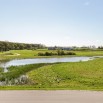
The event showcased three geothermal methods, with a display site at each. The first used the site’s pond and showed how geothermal tubing can be looped through the water and then into a home underground. The second was a display well where a drilling demonstration took place. The third was inside the equestrian center, where a packaged-unit geothermal heat pump was being demonstrated.
Evie Sibert of Climate Master, a geothermal systems firm, was on hand to explain the processes used by the various geothermal methods on display. Vendors from Climate Master and Connor Co. showcased the three different methods of providing geothermal heating and cooling to homes.
Geo Day
Who: Serosun Farms, a sustainable-living community, partnering with ClimateMaster and Conner Co., manufactur- ers and consultants on geothermal systems
What: Geo Day, an event that lets the public explore geothermal systems through demonstrations and discus- sions
Where: 45 W 489 Berner Road near Hampshire
When: Noon to 3 p.m. Saturday, Sept. 22
Cost: Free
Serosun Farms, a sustainable community near Hamp- shire, is holding a Geo Day for the public to learn about geothermal systems from noon to 3 p.m. Saturday, Sept. 22.
The farm is partnering with ClimateMaster and Conner Co., manufacturers and con- sultants on geothermal sys- tems for heating and air con- ditioning, for the event.
The event will include live demonstrations for install- ing geothermal systems for residential use, including drilling and installing the ground loops used to cap- ture the earth’s heat. Experts will demonstrate vertical and horizontal systems, as well as pond systems and setting up and tuning the geothermal systems.
National experts will be on hand to discuss the economic and health benefits of geothermal systems in sustainable and high performance homes.
“We are excited to host this event with ClimateMaster and Connor Co. and give area residents and professionals the chance to get a hands-on look at these systems. This is part of Serosun’s broader program to help educate the community on sustainable and high performance tech- nologies for homes,” said John DeWald, developer for Serosun Farms.
“We think that geothermal systems, if done right, provide a great opportunity to achieve energy savings and a more comfortable and safe home.”
For more information, go to the Serosun Farms web- site at serosunfarms.com or the ClimateMaster website at ClimateMaster.com, or call (847) 683-4796. Serosun Farms is a working farm with an equestrian center south of Huntley near Hampshire and Burlington in Kane County.
Serosun Farms has premium lots for sale and is cur- rently accepting reserva- tions. Once completed, it will feature 114 home sites with traditional architectural home styles (craftsman, farm houses, prairie and Victorian), eight miles of trails, a fishing pond, a world-class equestrian center, a community center and an organic farm.
Serosun Farms is located at 45 W 489 Berner Road near Hampshire. Take route 72 west from route 47 to Romke Road. Turn left on Romke and go 1 mile to our entrance at Berner Road.
Twenty-first century homes will not be like the childhood home you remember.
Changing lifestyles, advances in home technology and green building trends — with a focus on cost savings and energy efficiency — are beginning to reshape how homes are constructed today.
How would you like to drive home from work and have the ability to touch your iPhone to turn up the heat or switch on the lights before you arrive.
Or what about living as part of a 400-acre farm that is a sustainable community, where you can work with the animals and learn about organic gardening.
Let’s take a look at these evolving changes in home building.
Green building trends
Serosun Farms in Hampshire is an exclusive sustainable community like no other in the suburbs. Centered around a working farm, houses — from smaller cottages to country estates — will sit in clusters on 114 distinctive one-acre lots amid acres of open space, restored prairie and woodlands.
The developer adheres to design guidelines and other requirements for green building, and its green building team partners with contractors and vendors that provide sustainable materials and products.
Although Serosun Farms features a whole new level of sustainable living, mainstream builders also offer green options as buyers show more interest in aspects of green building, especially in regard to energy efficiency.
With all things considered, greener alternatives are less expensive than in the past. Therefore, interest is growing and green design and products are creeping into the mainstream.
Ray Blankenship, area vice president of K. Hovnanian Homes, says that while prices have gone down, green options are not as inexpensive as some of the other features people select for their homes
“We incorporate some green features as standard because they result in a better-built home,” Blankenship said. “We use high efficiency furnaces, water heaters and windows, things like that — things that save the buyer money.
“But otherwise, most people don’t want to pay the premium for green features. We still offer green flooring such as cork or bamboo, but people aren’t spending the money on it. They’re upgrading to a prettier cherry, oak or maple floor.
“We’re making headway with things that can save them money, but with things more visual, they’re sticking with the standard items.”
Bamboo flooring is considered a green building product because it is made from a fast-growing wood, rather than old-growth forests.
At Serosun Farms, green is anything but standard.
Every element of the community — the active agricultural operations, residential housing, equestrian center and the preservation and restoration of natural areas — is being developed to provide 70 to 80 percent of energy through clean, renewable, on-site sources, said John DeWald, developer of the community.
Sustainable high performance areas include energy and water savings, resource conservation and healthy clean indoor air quality.
“We use a geothermal system for heating and air conditioning, solar for energy generation, home automation for energy savings, and efficient building envelopes (the insulated shell of the home).
“We also use water-efficient plumbing and rain harvesting systems to better utilize water, and we use nontoxic materials inside the house.
“It takes a lot of different systems to put the house together to make them energy efficient, healthy, comfortable and cost-effective,”DeWald said. “In the end, building a sustainable home really makes sense.”
Home automation
Although a home automation system makes life easier for homeowners, area builders say most buyers aren’t interested in spending extra money for this newer technology unless they’re purchasing a high-end home from a custom builder.
However, Kim Meier, president of KLM Builders, says that home technology has advanced tremendously, and what makes it so exciting is that prices have come way down.
“Ten years ago, certain functions were cost prohibitive. Now, once you have the main brain (computer), which costs about $1,000, you have the ability to grow the system to what you want it to be and when you want,” Meier said.
The Sonoma model in KLM’s Thousand Oaks community shows an Apple iPad built into the wall.
“From that iPad station, there’s a multifunction screen that controls all the functions of the house. With the touch of a button, you can manage lighting, change temperature settings, or distribute audio into any room in the house. All these functions are available wirelessly.”
More specifically, if you wake up in the middle of the night and want to grab a bottle of water from the refrigerator, you push one button for 25 percent illumination of the path to the kitchen (or whatever illumination you program into the key pad).
“Every customer wants something slightly different, and we can customize as long as they have the main guts,” Meier said.
“We’re doing iPod or iPhone docks on kitchen counters. You can stick an iPhone in a receiver and play music on an iPad throughout the house. We’re also adding them to the nightstand in the master suite.
“With new home technology, some people are very in-tune and on board with it while others don’t have their toe in technology waters, and they kind of crawl into it.”
A sustainable lifestyle
While Serosun Farms offers the ultimate in sustainable living, it also offers beauty, tranquillity and a healthy lifestyle along with the experience for kids to grow up on a farm. “Most professional people don’t have the time or money to run a farm; here we do it for you,” DeWald said.
The development offers educational programs and several ways to take an active role in the community, such as in the demo gardens, prairie restoration or building birdhouses.
“With our demo gardens, we are in a five- to 10-year process of shifting to local market farming. Some gardenAmenities include eight miles of trails, sports fields, fishing ponds, playground, community center with swimming pool, game room and event facilities.
Also, a world-class equestrian facility is on-site developed by Jane Stickland, DeWald’s sister who lives on the property and is his business partner. An international trainer also lives on the site.
How do builders keep up with changes in the industry and the challenge of educating clients?
“We go to seminars and learn about new products,” Meier said. “We only use products that are tried and true. We have incorporated the same system used in the hotels in City Center in Las Vegas. It’s proven technology. It works. It’s reliable.”
KLM follows a process with each client that consists of a series of meetings, including a pre-construction meeting. One meeting focuses on electrical and technology where the builder and homebuyer review a schematic for each floor.
The builder asks a series of question: Do you want sound in any of these rooms? Do you want the ability to stream audio and video, and where?s test heirloom varieties of vegetables and various techniques,” DeWald said. “It’s a learning place.”
“We talk about the mechanical systems of the house. We like to put electrical technology systems in one corner of the basement so everything is gathered together,” Meier said.
“A lot of builders separate them. They place the furnace in the middle, the sump pump somewhere else and the electrical in another spot.
“We group everything together in a technology panel that will sit in the basement at one end next to the furnace and electric service. It’s a separate panel that almost looks like another electric panel.”
In the not-too-distant future it’s possible, and even likely, that new subdivisions or “sustainable community” developments will follow a blueprint similar to Serosun Farms in Hampshire, IL.
This residential development located on 410 acres in Kane County and about 65 miles west of Chicago features custom homes that emphasize environmentally sustainable living.
But it also offers surroundings that fit right in with that concept, giving the title of “sustainable community” some significant meaning, while establishing what many believe will be a growing trend.
The buyers of these homes will be working closely with the developer, John DeWald & Associates, when discussions take place about design and construction. Architects and builders at Serosun Farms incorporate passive design elements that take into effect wind and sun patterns.
Another key green feature is a rainwater collection system, and geothermal heating and cooling.
With the homebuilders focusing on building and design aspects that aid the environment, those who live in the community will notice plenty of other “green” aspects will become part of daily life.
The community offers a farmer’s market with fresh produce, flowers, free-range poultry, grass-fed beef and other specialty items.
Wildlife habitats and prairie restoration will be incorporated into the grounds and surrounding areas.
Hay will be produced to support an equestrian center in the community, while permeable driveways and prairie grasses will ease rainwater runoff.
Residents will have access to community garden plots, allowing them the option of growing their own vegetables and fruits.
http://www.pleaseconserve.com/this-sustainable-community-provides-blueprint-for-future-projects/
By Jean Murphy, Daily Herald Correspondent
Equestrian communities, where people who own, ride and train horses can enjoy their sport and socialize with others who enjoy it, too, have been around since farms began disappearing and horses were replaced by automobiles for everyday travel.
The most known such community around here is West suburban Wayne, home of the world-famous Lamplight Equestrian Center show facility and the Dunham Woods Riding Club, a private equestrian country club located in a small historic inn.
That tiny village of 2,407 people is committed to preserving its equestrian nature and reputation, allowing anyone with sufficient land to have a horse barn, and it is even the home of one of only two active fox hunt groups left in the Chicago area. The Wayne-DuPage Hunt Pony Club has been re-enacting traditional English fox hunts since the 1920s. But take note that today's hunters use “drag bags” containing fox scents. No foxes are actually used in hunts anymore.
The other such hunt held in the Chicago area, the Mill Creek Hunt, takes place in far North suburban Wadsworth, another equestrian community of note. Hunt Club Farms is a 681-acre community in nearby unincorporated Lake County that was developed during the 1980s to appeal to horse lovers.
Hunt Club Farms has the 124-stall Fields and Fences Equestrian Center within its borders. Residents may board, ride and train their horses at the center and participate in horse shows. Or, if they have 4.5 acres or more, they may build a barn to stable their horses privately. But no matter where they choose to house their horses, all residents have access to 10 miles of fenced equestrian trails and acres of open riding areas. They may also use Fields and Fences' two indoor riding arenas.
And now horse-lovers have yet another option if they are looking for a community where there is a readily available equestrian center and a system of bridle trails. Serosun Farms is being developed in Hampshire and its high-end training facility for sport horses and jumpers is already open and busy, according to Jane Stickland, owner, who has been involved with showing and training horses since the 1970s.
While Serosun Farms will have a strong equestrian component, it has actually been designed to solve the problem of disappearing agricultural land and to appeal to anyone who has always wanted to live on a farm or who is committed to living in an organic community, Stickland said.
Once complete, the 410-acre Serosun Farms will feature a 160-acre working, sustainable farm and apple orchard, which will supply fresh produce, flowers, farm-raised meat and other specialty items to an on-site farmers market. There will also be 300 acres of open countryside with eight miles of trails for riding, cross-country skiing, walking and golf carts. Finally, it will feature the equestrian center, fishing ponds, a wildlife habitat, sports facilities, a playground and a community center with swimming pool, game room and event facilities.
Homes will be built on 1-acre lots by John DeWald & Associates, the developer of Serosun Farms, and anyone who wishes to have a horse on-site will need to board it at the 40-stall equestrian center. No individual barns will be permitted.
“We have people looking here who have their own barns now and they no longer want the cost and labor to maintain it,” Stickland said. “Plus, having a number of small barns is not a good use of land from a sustainable perspective. You have all of the questions of maintenance and getting rid of the manure, which we have already addressed with our barn.”
When all is said and done, Stickland said the builder expects only about 25 percent of its buyers will bring horses with them or purchase them after they arrive. Yet, both adults and children are expected to take advantage of the riding trails and lessons, which will be offered.
Interestingly, real estate agents who sell in Hunt Club Farms near Wadsworth and in the village of Wayne said many residents of these areas, too, don't ride or own horses. They simply like the “acreage, privacy, beauty and peace” of more rural surroundings, said Lynn Purcell of Baird & Warner in Wayne. And many feel like living among horse people is like stepping back in time, she added.
Richard Capoccioni of RE/MAX Center in Grayslake, the top-selling Realtor for Hunt Club Farms, lives there himself and said 80 percent of his neighbors don't own horses. They just like to look at them and they like the fact that their children can take lessons at the equestrian center if they are interested.
Others maintain elaborate barns and even private indoor arenas, he said. And there is every possibility in between represented, as well.
“People who live in an equestrian community are looking for a certain lifestyle. And there is no doubt about it: places like Hunt Club Farms are very popular,” Capoccioni said. “The only question now is: Can you afford it?”
Prices in Hunt Club Farms and other equestrian communities have certainly dropped with the rest of the economy and they are generally sitting on the market much longer than they once did, Capoccioni admits. But owners who don't have to sell, aren't listing homes either.
So, only four or five properties are currently listed, at prices ranging from $485,000 to $1.3 million. And the properties that are selling are the heavily discounted ones that are in the midst of a short sale or foreclosure. There have been three such instances in Hunt Club Farms over the last few years, he said.
Compare that to the larger market, where his office's listings are now 70 percent short sales and foreclosures. The higher price range homes have not yet been hit as hard by dire financial difficulties, Capoccioni said.
Wayne horse properties have also felt the pinch of the market, Purcell said. In 2005-2006, she said, 27 homes with land that could accommodate horses sold in the town. An additional five empty lots that could accommodate a house and barn also sold. By 2008-2009, that number of sold properties had dropped to only four. During 2010, only two such properties found buyers.
Horse-capable properties currently listed in Wayne primarily range in price from $449,000 to $2.5 million, she said. There is one property, however, which is listed for $9.5 million and some listings have languished on the market for up to two years, Purcell said.
Stickland and her partners feel that the less-exclusive atmosphere of Serosun Farms and the fact that it will also appeal to eco-conscious people who want to live in a sustainable, organic community and to those who have always wanted to live on a farm without doing all of the work involved, will help them weather the recession better than most.
Homes built in Serosun will be required to go through a certification process to prove they are 80 percent more energy-efficient than a traditional home and use 50 percent less water.
Even the barn will soon be LEED-certified and it already has an advanced ventilation system and an innovative composting program for the manure, which is used on site as fertilizer.
“Serosun Farms will be so much more than an equestrian community,” Stickland said. “But it will also be absolutely ideal for those who do want to ride and have their horse nearby.”
http://www.dailyherald.com/article/20110226/entlife/702269961/